Briefy vs. Recall: The Second Brain Showdown
Transcript
Made automatically from the video's sound, so it may contain mistakes. Click a line to play from there.
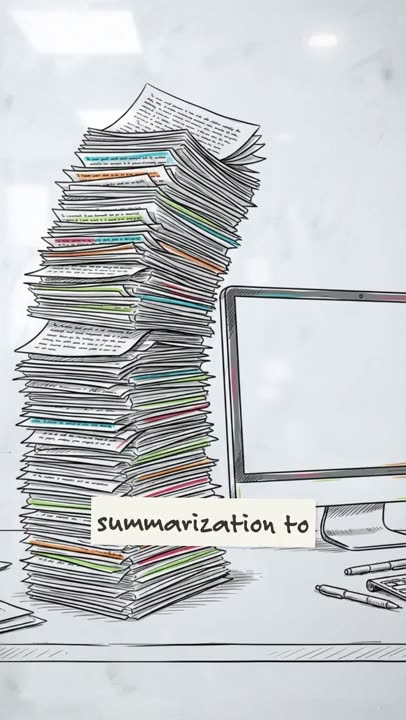
Every day, you deal with a massive influx of information. Two hour podcasts, dense 50-page PDFs, and a never-ending stream of industry news articles all demand your attention at the exact same time. This chart shows the real problem.
The volume of digital text generated globally is growing on a steep exponential curve, while your physical capacity to read and process that text hasn't changed at all. Throwing a generic AI chatbot at this problem usually creates more work. You have to write precise prompts, copy and paste massive walls of text, and deal with the AI constantly losing the context of longer documents.
That friction is why a new category of specialized software has emerged browser-based AI summarizers. These tools live directly where you consume content and digest complex material instantly, without requiring you to type a single conversational prompt.
Ultimately, surviving this avalanche of content requires a shift in strategy. The goal is no longer trying to read faster. The goal is extracting usable, accurate insights without losing the original author's intent.
Heading into 2026, Briefey and Recall have established themselves as the two leading browser-based summarizers on the market. Both platforms run on advanced natural language processing, or NLP. To understand how they differ, you have to understand the two distinct ways NLP handles text.
The first method is extractive summarization. The AI scans a document, identifies critical sentences, and pulls them directly out, word for word. The second method is abstractive summarization.
The AI comprehends core ideas and generates entirely new, coherent sentences to explain concepts concisely. Briefy and recall both utilize a hybrid of these two methods to ensure their summaries are highly readable without sacrificing factual accuracy.
With the underlying technology being so similar, the decision depends on whether you need immediate point-in-time extraction or long-term knowledge mapping. Briefe operates as a tactical exoskeleton for your daily workflow. It is built entirely around immediate action and meeting preparation.
It handles heavy, multimodal inputs with ease. You can feed it 50 megabyte PDFs or hours long YouTube videos, and it processes them directly in the browser. The interaction is incredibly simple.
When you're viewing a complex document or video, you click a single magic button in your browser extension, and the AI takes over. As this diagram shows, briefy converts that long-form content into structured visual formats.
Depending on what you need for your work, you can command Briefy to outdate the information as a hierarchical mind map, a chronological timeline, or a cleanly categorized data table. The main trade-off with Briefy's approach is isolation.
It treats every summarized document as a standalone event. The data you process today remains siloed from the data you process tomorrow unless you manually search your history. Briefie is optimized for the professional who needs to survive today's immediate tasks.
It delivers structured comprehension of a single file exactly when you need it. Recall operates on a completely opposing philosophy. It functions as an automated second brain, designed specifically for long term storage and synthesis.
As you browse the internet, you save web articles, podcasts, and news items directly into the recall system. From there, the AI takes over the administrative burden. Recall automatically categorizes your saved content, entirely eliminating the need for you to manually tag files or organize folders.
This diagram shows the core feature separating recall from standard summarizers, the automated knowledge graph. When saving a new podcast summary, the system actively scans your history, drawing glowing connections to related articles saved months prior, revealing thematic relation is speed.
If you need a quick billeted list of a contract for a meeting that starts in five minutes, recall's deep linking ecosystem is severe overkill. Recall trades the immediate utility of a structured table for serendipitous discovery.
It is built for holistic learning and the slow, steady construction of a personal database. Using AI to summarize your work introduces serious hidden risks. You have to account for data privacy, corporate supply chain vulnerabilities, and strict enterprise IT policies before uploading documents to a third party.
Briefy addresses this friction directly. It holds verified enterprise security credentials, including SOC 2, ISO 27001, and GDPR compliance, ensuring your data is handled securely. This enterprise focus is reflected in the pricing.
Recall offers a flat subscription of $7 per month. Briefe's Ultra Tier, which includes the largest file allowances, costs nearly $14 per month. This quadrant chart maps the exact trade-off between cost and capability.
Briefy sits in the upper left, providing high security, multimodal action. Recall sits in the lower right, offering affordable text based long term storage. Briefe's higher price point serves as a necessary premium. In strict corporate environments, IT departments will outright block unverified software, making briefy's compliance certifications the only way to utilize AI summarization at the office.
Software purchasing decisions should be based entirely on eliminating your primary daily friction, not the hype surrounding an AI model. This decision tree flow chart breaks down exactly how to choose. We start with the first constraint.
Are you dealing with highly sensitive corporate data or large PDFs? If yes, the secure infrastructure of briefy is mandatory. If no, ask yourself is your primary goal connecting disparate ideas over months of continuous research?
If so, your answer is recall. If you instead need immediate visual outputs like mind maps right now, then briefy is your tool. Identifying whether your core problem is immediate comprehension or long-term retention dictates the correct software choice.
Let's assign these tools to specific professional profiles. Profile one is the tactical executor. This includes consultants, lawyers, and corporate managers. Briefy is the superior choice for this group.
It securely handles large, multimodal files and translates that data into actionable mind maps you can use immediately in a boardroom. Profile 2 is the synthesizer. This encompasses academic researchers, students, and content creators.
Recall is the choice for the synthesizer. For $7 a month, its automated knowledge graph actively draws connections across vast amounts of disparate media over time. There is one exception.
If you are a casual reader who only needs occasional web summaries, avoid both paid tiers entirely and stick to basic free browser tools. Mastering the modern avalanche of content requires choosing the AI methodology that accurately matches your specific intellectual goals.