The Series Finale
Transcript
Made automatically from the video's sound, so it may contain mistakes. Click a line to play from there.
Welcome back to the highly anticipated series finale of our explainer. Right, so picking up from our last explainer on zero knowledge proofs, having seen what maths can miraculously prove without revealing secrets, today we are slamming directly into the absolute mathematical wall of what no compiler, static analyzer, or frontier AI model in the universe can ever decide for all programs.
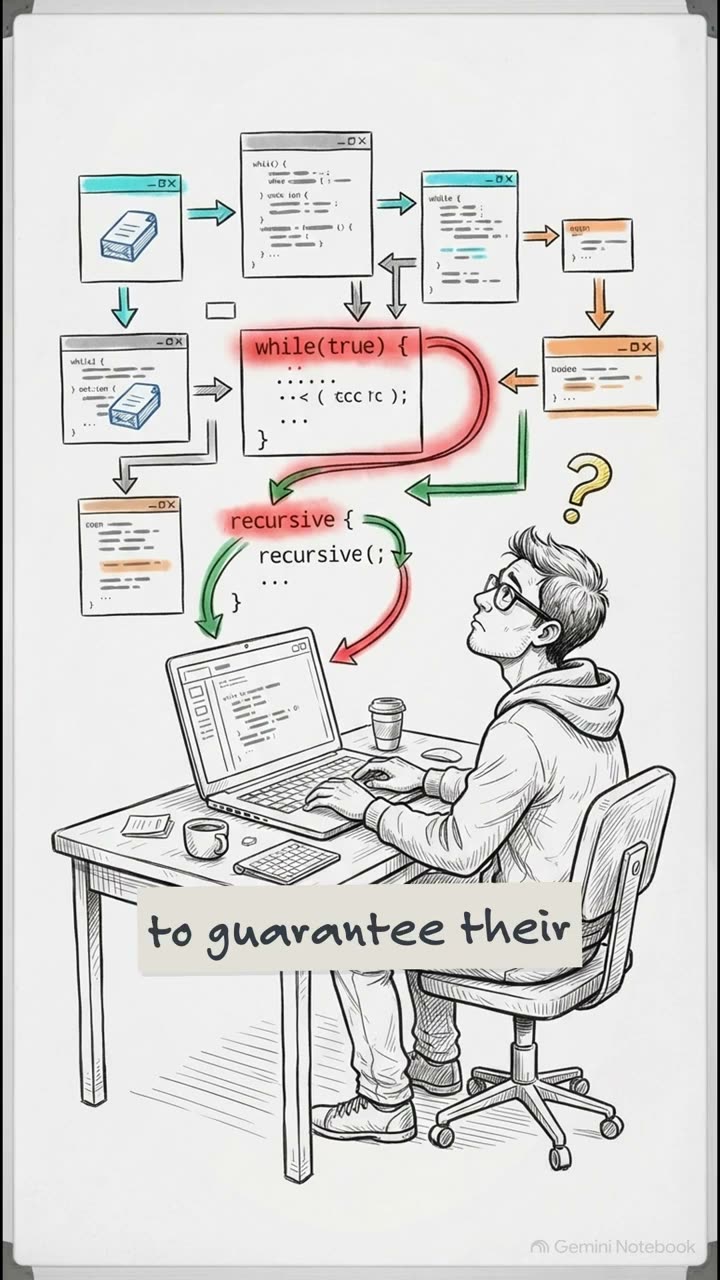
So if you've ever found yourself wondering why your code suddenly gets stuck in an infinite loop, or how a single regular expression can take down an entire global network, or you know, why autonomous AI coding agents can just suddenly spiral into these unstoppable recursive traps.
Well, I've got news for you. The answer doesn't actually lie in bad engineering. It literally lies in fundamental mathematics. Here's what we're covering today: the absolute mathematical wall, accidental Turing completeness, the Cloudflare rejects outage, winning by banning infinity, the AI Vibecoder trap, and finally our series finale wrap-up on human invariance.
Let's get straight into it. Part one, the absolute mathematical wall. Let's wind the clock back a bit. In 1928, David Hilbert was on a quest for a universal truth algorithm.
Well, Gürtel completely shattered that dream in 1931 with his incompleteness theorems. But beneath all that is Georg Cantor's brilliant realization about the profound gap between uncountable specifications and countable programs.
And all of this culminated in 1936 with the Church Turing thesis and Turing's halting problem. Turing mathematically proved that some problems fundamentally cannot be solved by any mechanical process.
And yes, that absolutely includes today's most advanced GPU-hosted LLMs. Just take a look at this. This is the actual artifact of Turing's genius from his 1936 paper. He used what's called a diagonalization proof to show there is simply no way you can build a universal machine that decides if all other programs will halt.
And then, jumping to 1953, Rice's theorem extended this. It essentially says that every non-trivial semantic question about a program, questions like, can this code ever hit null, will it leak data, or is it vulnerable to injection?
All of that is fundamentally undecidable. Now, to really grasp why modern static analyzers and compilers always have to deal with false positives or false negatives. We have to ask ourselves a genuinely mind-bending question.
What on earth happens if we feed a hypothetical perfect bug checker its very own output? Imagine you write this flawless analysis tool, let's call it Haltz P. It promises to look at any program and tell you definitively if it will finish or just loop infinitely.
This is captured so beautifully in Jeffrey Bullen's poem, which itself is rooted in Christopher Strakey's logic. Basically, if you feed your perfect bug checker into a five-line inverter program, let's call it Q, you create an impossible paradox.
You design cues so that if the checker says Q will loop, Q just halts immediately. But if the checker says Q will halt, Q deliberately loops forever. It's a complete contradiction that destroys the very concept of perfect program prediction.
It proves without a doubt that perfection is impossible. Part two. Accidental Turing completeness. You see, Turing completeness hides in plain sight.
In environments that were never ever intended to be universal computers, developers have stumbled into infinite power. Take TypeScript, for example. Through recursive mapped types, developers have actually implemented prime number checkers that completely froze the compiler itself.
I mean it's infamously documented in issue 14833. And you'll find the same accidental universal computation hiding in SQLs with recursive, C templates, and even CSS and HTML. It's incredibly dangerous because an environment you assumed was limited can suddenly be tricked into spinning forever.
Because predicting code behavior is a mathematically undecidable reality, language designers have to face MapMite's classic trade-off, completeness versus soundness. They literally have to choose between missing some bugs or rejecting perfectly good code.
Take Rust's borrow checker, for example. It uses sound static analysis. It conservatively bounds behavior, meaning it happily accepts false positives, rejecting completely valid safe code, just to mathematically guarantee you never get a false negative.
Part three, the Cloudflare regex outage. Let's contrast explosive PCRE backtracking engines, where the worst-case complexity is exponential, we're talking order 2 to the power of n, against safe non-backtracking engines, pioneered by Russ Cox with Thompson NFA Automata.
These are used in things like RE2, Rust Regex, or Go. They execute safely in linear time, order M times N. They safely bound the execution so it can never spiral out of control. 27.
That is the number of minutes Cloudflare's global network went completely down on the 2nd of July 2019. And why? Literally because a single backtracking regex in their web application firewall was deployed globally.
It was trying to match anything followed by anything in a nested group. A crafted input caused catastrophic exponential backtracking and instantly pinned their global CPUs to nearly 100%. The entire internet essentially broke, all because the system allowed unbounded complexity.
Part 4. Winning by banning infinity. If unbounded capability is a systemic vulnerability, the only way resilient production systems survive is by deliberately banning infinity.
The Linux kernel's eBPF verifier is a sheer masterpiece of this philosophy. Before it lets sandboxed code run deep inside the kernel, it simulates execution paths using a directed acyclic graph. It mathematically guarantees finite complexity, containing only bounded loops, making sure it will actually finish executing without accessing memory out of bounds.
If it can't prove it halts safely, the code is flat out rejected. We see similar things with Google's common expression language, Operago and DAL, which secure configurations by explicitly rejecting Turing completeness. By removing infinity, you open the door to using automated Z3 SMT solvers, or Lamport's TLA Plus, to formally verify safety invariants across the entire input space.
Even Ethereum has to rely on strict gas metering to bound execution and survive. Basically, when you ban infinity, formal verification suddenly becomes possible. Part 5. The AI Vibecoder trap.
Now, let's apply these hard-won lessons to the modern frontier. As warned by the UK NCSC and Simon Willison, treating a large language model as a 100% sound bug or prompt injection oracle is a highly dangerous default. AI essentially auto-completes the statistical happy path, and it will casually emit catastrophic backtracking regexes, completely unaware of the exponential blowup just waiting to happen.
This is officially known as CWE 1333, or RedOS. The vibecoder trap is incredibly real. If you place an autonomous AI agent in a loop with tools and you don't give it bounded execution environments, it will inevitably stumble into accidental Turing completeness.
It'll try to avow user filters, it'll generate runaway regex, and it will spiral into unstoppable CWE 835 and OWASP LLM10.2025 autonomous agent loops. Let's remember the fundamental rule. No AI in the universe can solve the halting problem.
Part 6. Series finale. Human invariance. To survive this, you need to adopt what we call the Judicious AI Prompting Playbook.
Now, you don't need to write TLA plus mathematical proofs or custom DSLs for a simple database CRUD app. Those are Yagney guardrails, as in you aren't gonna need it. But you absolutely must reserve bounded languages like CEL or RE2 for untrusted inputs.
Enforce hard timeouts, max iterations, and tight cost budgets. And whatever you do, never ever grant an AI unsandboxed Turing complete access to your critical state machines. Through all 13 episodes of this explainer, across the starting three, time and order, deceptively broken primitives, and finally memory and theoretical limits, this is the ultimate lesson.
AI is a breathtakingly powerful engine. It will write your boilerplate and pave that statistical happy path faster than we ever could. But navigating the absolute mathematical walls of computer science, ensuring that failure is safe instead of a total catastrophe, that remains the solemn duty of the human architect.
AI auto-completes the code, but we must supply the invariants. So, as we finally wrap up this series, I want to leave you with a final thought. Turing proved back in 1936 that perfection is mathematically impossible. The halting problem literally guarantees that bugs and unpredictable behaviors will always exist in Turing-complete systems.
The question isn't whether your code will fail. The question is: will you blindly yield your systems to the dangers of unbounded statistics, or will you deliberately master the mathematical boundaries of computation and design your systems to fail safely?
Thank you so much for joining me on this incredible journey. Keep building, keep setting those hard limits, and keep exploring.