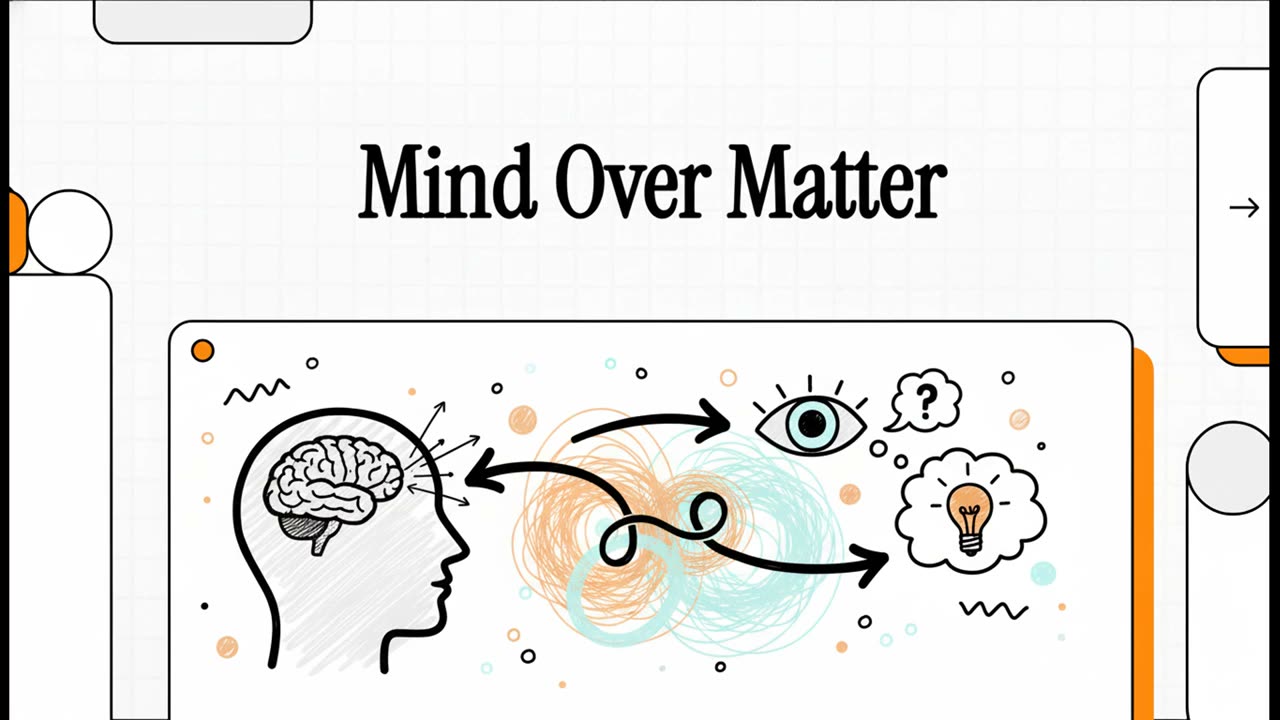
Mind Over Matter
Transcript
Made automatically from the video's sound, so it may contain mistakes. Click a line to play from there.
Alright, today we're diving into something pretty wild the intersection of belief, biology, and the brain. Let's get right into it. So let me ask you something that sounds like it's straight out of a sci-fi movie.
Can you actually change reality just by thinking fast? Well, there's this one method out there that claims, yeah, you totally can. The idea is you spin images in your mind, like pictures of your goals, so fast they just become a blur.
I know, it sounds kind of out there, right? But before we dismiss it, we have to figure out if it could work. And to do that, we first need to understand the science of how we see things in the first place.
And believe it or not, the answer starts with something you probably never think about the hard limits of your own eyes. It all comes down to a really basic question. What's the actual frame rate of your vision?
Yeah, that's right. Your eyes and your brain actually have a very real, very measurable speed limit. And that limit has a name. It's called the flicker fusion threshold.
Basically, it's the exact point where a blinking light starts to look like a solid, steady beam to us. You can think of it as the frames per second or the refresh rate of your own vision. But here's the thing this speed limit isn't the same across the board.
You've got two types of photoreceptors in your eyes, right? The rods, which handle low light vision, are kind of slow. They top out around 15 Hertz. But your cones, the ones that see color and all the fine details, they're way faster, hitting about 60 hertz.
And hey, that's not a coincidence. It's exactly why most of our TV and computer screens refresh at 60 Hz. They're built for our eyes limits. So what happens when something moves faster than our eyes can keep up?
Well, our brain gets tricked. This is called the stroboscopic effect. You've definitely seen this before. It's why a spinning car wheel in a movie can look like it's standing still or even going backward.
What's happening is your brain is just taking a series of quick snapshots and trying its best to connect the dots, and sometimes it gets it wrong. It's a perfect example of how what we see isn't a live video feed of reality, it's a reconstruction.
Okay, so that's the limit for what we can see with our eyes, but what about what we can imagine in our heads? Right, so we have a clear biological speed limit for processing images coming in from the world.
But what about the other way around? What happens when the images are being generated from the inside? Is there a speed limit for our imagination? And this is where we get back to that technique I mentioned from a researcher named William Bankston.
His image cycling method has three basic steps. First is dreaming, where you just make a list of about 20 things you want. Then comes drilling. You mentally cycle through images of those things really fast, one after another, but without getting all emotional about it.
And finally, you get to hypercycling. This is where you spin the images so fast they completely detach from your conscious thought, becoming this kind of background blur you can have going while you're doing other stuff.
Now, the key thing to get here is that this is the exact opposite of most meditation. You're not trying to slow your mind down and find calm. No, no, the goal here is to speed it way up, to push your brain into these really high-frequency gamma and lambda brainwave states, which interestingly are often associated with intense focus and those aha moments of insight.
I know, I know, this all sounds pretty abstract. But what does the actual neuroscience say about all this? Like what really is the difference in your brain between seeing something for real and just imagining it?
Well, the answer is kind of mind-blowing. Turns out there's a huge overlap. When you see an object versus when you just imagine that same object, many of the exact same parts of your brain light up.
The areas you see here in red and yellow show that functionally your brain is doing almost the same thing in both cases. And we're not talking about some tiny little area. This shared neural real estate, this overlap, it extends all over the place.
It goes from the visual cortex at the back of your brain, the part that processes raw data from your eyes, all the way up to the frontal cortex, which is in charge of all our complex, higher level thinking. Okay, so if seeing and imagining use the same brain hardware, what makes them feel so different?
I mean, why don't we just confuse our thoughts with reality all the time? The key difference isn't the hardware at all, it's the direction the information is flowing. See, perception, actually seeing something is what's called bottom-up.
It starts with an external stimulus, like light hitting your eyes, and that data travels up the chain to your visual cortex to be processed. But imagining something, that's top-down. It starts internally with a memory or an idea in your frontal cortex, and that information is sent down to light up the very same visual areas.
It's a really simple way to think about it, but it's profound. Seeing is like your brain reading data from the world. Imagining is like your brain writing data onto itself. So let's pull all these threads together.
This really helps us redraw the map of how our minds work. The reason a vivid imagination can feel so incredibly real is because on a neural level it pretty much is real. Your brain is running the same software on the same hardware it uses to see the actual world.
And that's why visualization is such a powerful tool, right? It's why athletes, artists, surgeons, anyone learning a new skill uses it to get better. In fact, it goes even deeper.
Some neuroscientists argue that all of our perception is basically a kind of controlled hallucination. Your brain is constantly making its best guess, a prediction, about what it expects to see out there.
Then it just uses the data from your eyes to correct any errors in its guess. So, in a way, the reality you experience is a simulation generated by your brain that's just being fine tuned by the outside world. And that brings us right back to where we started.
If your brain uses the exact same circuits to see the world as it does to imagine a world, if the only difference is whether the signal is coming from the bottom up or the top down, then what really is the boundary between perception and creation?