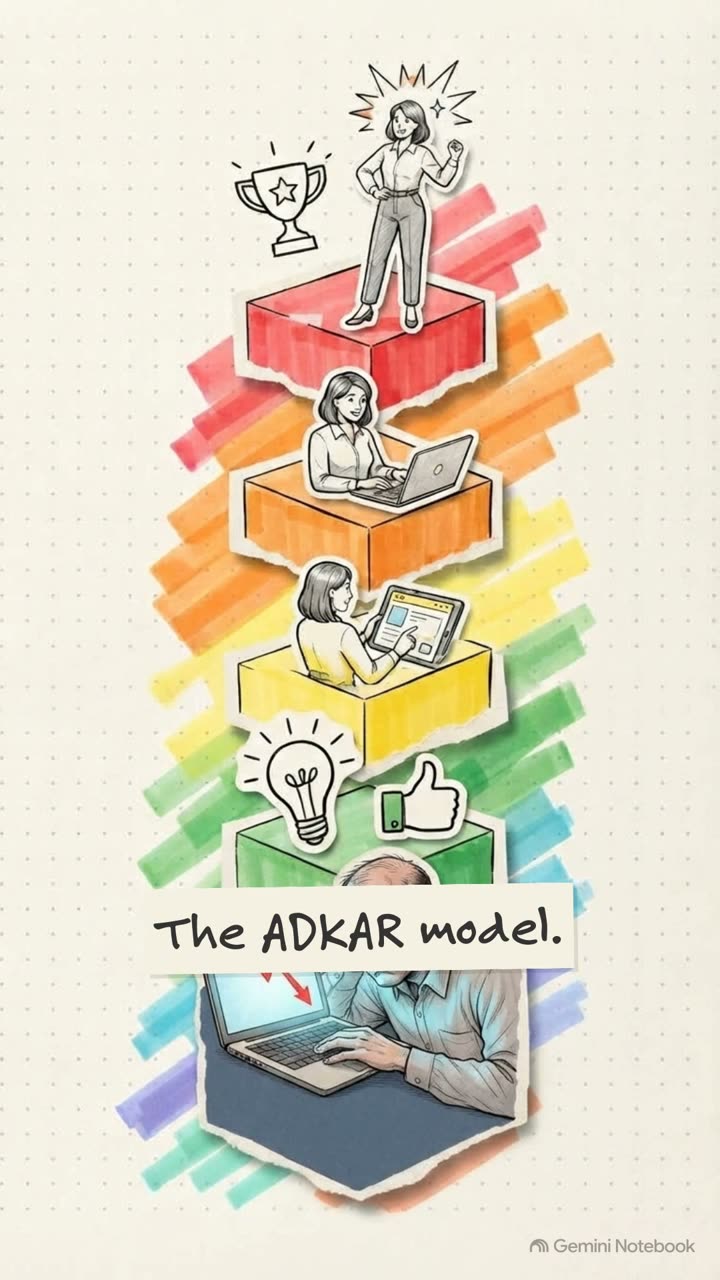
The ADKAR Framework
Transcript
Made automatically from the video's sound, so it may contain mistakes. Click a line to play from there.
Hey everyone, and welcome to This Explainer. I am so thrilled you're here, because today we're decoding something absolutely fascinating. How human beings actually navigate transformation.
You know, whether it's a massive corporate restructure impacting thousands of people, a community wide environmental push, or just frankly, trying to get yourself to finally stick to a new morning habit. Change is at the core of our lives.
But as we all know too well, getting it to stick is incredibly tough. We've all seen those grand plans just fall apart, right? So today we're gonna unpack the actual mechanics of human change and give you a master blue point to understand exactly how transformation happens.
Let's kick things off with a pretty wild statistic. According to the research, a staggering 70% of change initiatives fail. Just let that sink in, seven out of 10. And here's the thing they don't fail because the new software is glitchy or the business strategy is mathematically flawed, they fail because they completely ignore the people dimension.
We spend millions of dollars and thousands of hours on the technical side of a transition, but we completely forget the humans who actually have to do the changing. So that brings us to the central mystery of our explainer today. Why is human change so incredibly difficult?
Why do we instinctively resist new systems or new routines, even when we know for a fact they might be good for us? It's not just stubbornness, it's literally human nature. We want to understand the reasoning behind an action.
So how do you systematically guide someone from a place of active folded arms resistance to enthusiastic participation? Here is our cognitive roadmap for today. First, we'll look at the challenge of change.
Second, we'll impact the eight car model. Third, real world eight car applications, and finally, strengths and weaknesses. Let's jump right into part one the challenge of change. The entire foundation of what we're talking about today rests on this single powerful phrase organizations do not change, people do.
It sounds simple, but honestly, it is a radical shift in perspective. Successful change only happens when individual transitions match the pace of the organizational transitions. You can re-engineer a process all day long, you can launch the slickest new tech platform, but if that single employee sitting at their desk doesn't transition successfully, the whole thing stalls.
Macro level success relies entirely on micro level human adoption. Which leads us perfectly into part two unpacking the ADKR model. Enter the ADCAR model. And hey, this wasn't just dreamed up overnight in a boardroom.
This framework was developed by a research organization called Procy and popularized in Jeff Hyatt's 2006 book. It's the result of rigorous analysis drawn from over 900 organizations across 59 countries over a full decade.
It was literally born out of asking project managers on the ground why some initiatives succeeded while others completely crashed and burned. So this is built on hard, real world data. The model itself is an acronym.
ADKR stands for awareness, desire, knowledge, ability, and reinforcement. Think of this as the complete architecture of change. It provides the essential building blocks for individual transformation, moving the focus away from just the tasks a manager has to check off, and toward the actual outcomes the individual needs to experience to make a change stick.
Now, here's the absolute kicker. You have gotta think of these as sequential building blocks. This sequence is strictly non-negotiable. You cannot jump to knowledge if desire is missing.
If you try to send someone to training, which is knowledge, but they don't actually have the desire to be there, well, the structure just collapses. They won't learn a thing. Every single step must be completed before moving on to the next.
You have to build the foundation first. Now, what's really fascinating is the complex psychological map behind the very first block, awareness. Awareness is understanding why the change is necessary and the risk of not changing.
But it's not just about sending out a memo. If the sender of the message lacks credibility, or if there's a swirl of rumors going around, awareness totally stalls. Plus, if someone is highly comfortable with the status quo, they'll actively look for reasons to discredit the change.
So building awareness really means cutting through all of that psychological noise. Then we move to the second block, desire. A lot of managers make this mistake. They think if they just logically explain why a change is happening, people will magically want to do it.
Yeah, not true. Creating desire is tricky because ultimately it's a personal choice. It taps directly into WIFM, what's in it for me. It relies heavily on a person's unique life situation and their intrinsic motivators.
You can't force desire. You have to thoroughly understand the individual to cultivate it. Once you've got awareness and desire nailed down, the final three blocks kind of fall right into place.
Knowledge is all about the training and resources required to know how to change. But as we know, knowing isn't doing. That's where ability comes in. Ability bridges the gap between theory and actual practice, overcoming psychological blocks or physical limitations.
Finally, we have reinforcement, ensuring the change sticks permanently through meaningful rewards and accountability mechanisms, so people don't just snap back to their old comfortable habits. Okay, so that's the theory.
Let's move to section three real-world aid care applications. Driving change in the public sphere where you literally have zero direct control over your audience is the ultimate test for this. Take pineapple farmers in Ghana.
To get them to adopt new safety codes, officials built awareness by highlighting a massive risk. If they didn't comply, lucrative UK supermarkets wouldn't buy their crops. Boom, instant awareness.
Or look at Grad's Austria. To reduce emissions, they offered reduced parking tariffs for low-emission vehicles, making the benefit highly visible. And the EPA partnered with Dell to build awareness around the dangers of dumping PCs in landfills.
These are brilliant ways to cultivate that first step in large, uncontrolled groups. A truly fascinating objective case study here is the debate around the Kyoto Protocol. Back in the late 90s, this massive initiative stalled right at the very first block, awareness.
Why? Because the reasons for change were highly contestable at the time. But notice how it shifted. Fast forward to 2005, and the resistance had actually moved to the second block, desire.
The debate wasn't primarily contesting the science anymore, but rather focusing on economic impacts and national exemptions. The nature of the resistance successfully moved from the A to the D in EdCAR. Honestly, my favorite real world application comes from 1993 with Patricia Griffin and the Green Hotels Association.
Imagine trying to get thousands of transient hotel guests to change their daily habits. She did it with a simple little card hanging in the bathroom. It built awareness of wasted water and desire with the phrase, decide for yourself.
But the true genius is the messaging: a towel on the rack means I will use it again. A towel on the floor means please exchange. This brilliantly executes the knowledge and ability steps. It tells you exactly how to change and makes doing it incredibly simple.
As powerful as ADCAR is, we need to be objective. Let's head into our final section: strengths and weaknesses. The clear strength of AidCAR is its practicality. It acts as an incredible micromanagement checklist and is phenomenally effective for incremental changes.
However, critics point out some very valid weaknesses. As thought leader William Bridges points out, AidCAR largely ignores the deep emotional realities of transition. Change is what happens to you, but transition is what you experience emotionally and involves loss, letting go, and grief.
AidCAR's highly process-driven nature can sometimes completely miss the profound emotional handholding required for massive, culture-shocking step changes. So let's bring this home and make it personal. I want to leave you with a challenge.
Think of a change you're struggling to make or resisting right now in your own life or career. Which of those five blocks is missing? Is it awareness?
Do you not really understand why it's needed? Is it desire? Do you just not want to do it? Is it knowledge, ability, or reinforcement?
Somewhere in your own life, a block is missing and your structure for change is collapsing. Find that missing block, and you just might unlock your own transformation. Thanks so much for joining me for this explainer.