AI Concepts: Deep Dive
Transcript
Made automatically from the video's sound, so it may contain mistakes. Click a line to play from there.
Welcome to this explainer. Look, if you're building locally or running inference on cloud clusters, you already know the absolute pain of running out of memory. It is the bottleneck.
So today we're diving straight into the deep mechanics of memory and optimization for massive language models, and we're looking at the absolute cutting edge of compression and serving. Okay, let's jump right into our structural blueprint.
We'll start with the brutal math of the VRAM bandwidth bottleneck, move into taming outliers with post-training quantization, look at Hessian and activation aware methods, explore low-rang adaptation and QLaura, eliminate waste with page detention, and finally we'll touch on knowledge distillation into smaller models.
Right, section one. The VRAM bandwidth bottleneck and the math of memory limits. Let's start with the absolute central problem facing technical builders right now. Why exactly is single stream token generation strictly memory bandwidth bound?
You know, you might naturally assume that raw compute power is the bottleneck. But the reality of auto-regressive generation is just incredibly demanding on your system's memory. To generate one single token, your system has to load both the massive model parameters and all the intermediate states into memory.
That means your data transfer speeds strictly dictate your generation speed, not just your processor's calculation speed. Three terabytes. Honestly, that number perfectly illustrates the crisis we are facing.
Think about this. For a batch size of 512 and a context length of 2048, the KV cache alone totals an astonishing three terabytes. That's literally three times the size of the model itself.
It is mathematically impossible to serve these models efficiently at scale without radically rethinking how we handle the memory footprint. Taming outliers with PTQ mechanics and slicing away inefficiency. So post training quantization, or PTQ, acts as our first real surgical scalpel here.
But you might wonder why can't we just simply compress these models to save space? Why does naive 8-bit quantization fail? Well, it's all about the incredibly high dynamic ranges in the activations. Once models scale past about 6.7 billion parameters, these highly systematic emergent outlier features start to appear.
And these extreme outliers can be up to 100 times larger than the normal values. If you naively just squash all of that into an 8-bit space, you completely destroy the model's predictive capabilities, which obviously results in massive performance degradation.
To actually fix this, we have a technique called LLM.int8, which uses a really brilliant mixed precision decomposition procedure. First, it performs vector wise quantization for the standard features, safely bringing them down into 8-bit.
But then it mathematically isolates those critical emergent outlier dimensions and keeps them in a higher precision 16-bit matrix multiplication. And because these outliers make up just a tiny fraction of the total weights, we can safely multiply over 99.9% of the remaining values in 8-bit.
The results is that we literally halve the memory required for inference without losing any precision whatsoever. It's a game changer. Hessian and activation aware quantization, pushing to three and four bits.
Okay, so how do we push this compression down even further, to say just three or four bits? Enter Hessian guided error compensation. This is a technique used in GPTQ, and it essentially identifies parameter sensitivity using approximate second order information, so the Hessian matrix, to greedily quantize weights while actively minimizing the mean squared error.
GPTQ fundamentally treats weight quantization as a pure optimization problem. And by doing this, it can accurately compress a massive 175 billion parameter model into just three or four bits in roughly four GPU hours. That allows, for the very first time, generative inference of a model that size inside a single GPU.
Meanwhile, taking a slightly different route, we have AWQ, or activation aware weight quantization. AWQ protects just 1% of the salient weights to significantly reduce error. But the truly clever part is that it scales these channels based on offline activation statistics, rather than the weights themselves.
The authors actually mathematically proved that scaling up these salient weight channels slashes the quantization error, and it entirely bypasses the need for hardware inefficient mixed precision formatting. Low-rank adaptation and QLaura.
Efficient fine-tuning at scale. Now we've talked a lot about compression for inference, but how do we efficiently fine-tune these massive models once they're compressed? Well, LoRa works by completely freezing the massively dense pre-trained weight matrix.
Instead of trying to update billions of parameters, it just injects tiny, trainable low-rank matrices, usually labelled A and B. This cuts the optimizer memory by orders of magnitude. And the best part?
These matrices can be merged seamlessly back into the main weights at inference time, giving you absolutely zero latency penalty. QLARA then takes this a step further by using paged optimizers to manage any unexpected memory spikes during processing, which keeps the whole operation incredibly smooth.
The absolute foundation of QLARA is normal float 4, or NF4. It's an information theoretically optimal 4-bit data type designed specifically for model weights initialized from a normal distribution. So, QLaura backpropagates gradients through a frozen 4-bit quantized model.
But to squeeze out literally every last drop of efficiency, it applies a nested double quantization trick. It literally quantizes the quantization constants themselves. That neat trick saves an additional 0.4 bits per parameter, and it does it without any performance cost.
For those of you actually building locally, how does this translate into practice? Well, the bits and bytes library makes 8-bit optimizers and 4-bit data types like NF4 widely supported across Nvidia GPUs, Intel XPUs, Gaudi HPUs, and yep, even CPUs. LLM.int8 is rock solid on Nvidia architectures from Turing onwards.
It really is a fantastic toolkit for dramatically reducing memory consumption on basically whatever hardware you happen to be running. Alright, section 5. Eliminating waste with paged attention.
System level serving breakthroughs. So, having successfully compressed the model weights, let's zoom out to the system memory level and tackle that massive 3TB KV cache problem we highlighted earlier. You see, a standard KV cache requires contiguous memory allocation.
And because a request's memory grows and shrinks dynamically during text generation, this contiguous requirement leads to massive fragmentation and a ton of memory waste. Enter paged attention, the engine behind VLLM.
Inspired by classic operating system paging, it slices the cache into virtual memory style blocks. This enables flexible sharing of the KV cache within and across requests, which achieves near zero memory waste.
And by resolving that fragmentation, paged attention actually allows for continuous batching. When tested against state-of-the-art systems like Faster Transformer and Orca, VLLM's paged attention improves model throughput by up to two to four times, averaging about 3.5 times improvement, with exactly the same level of latency.
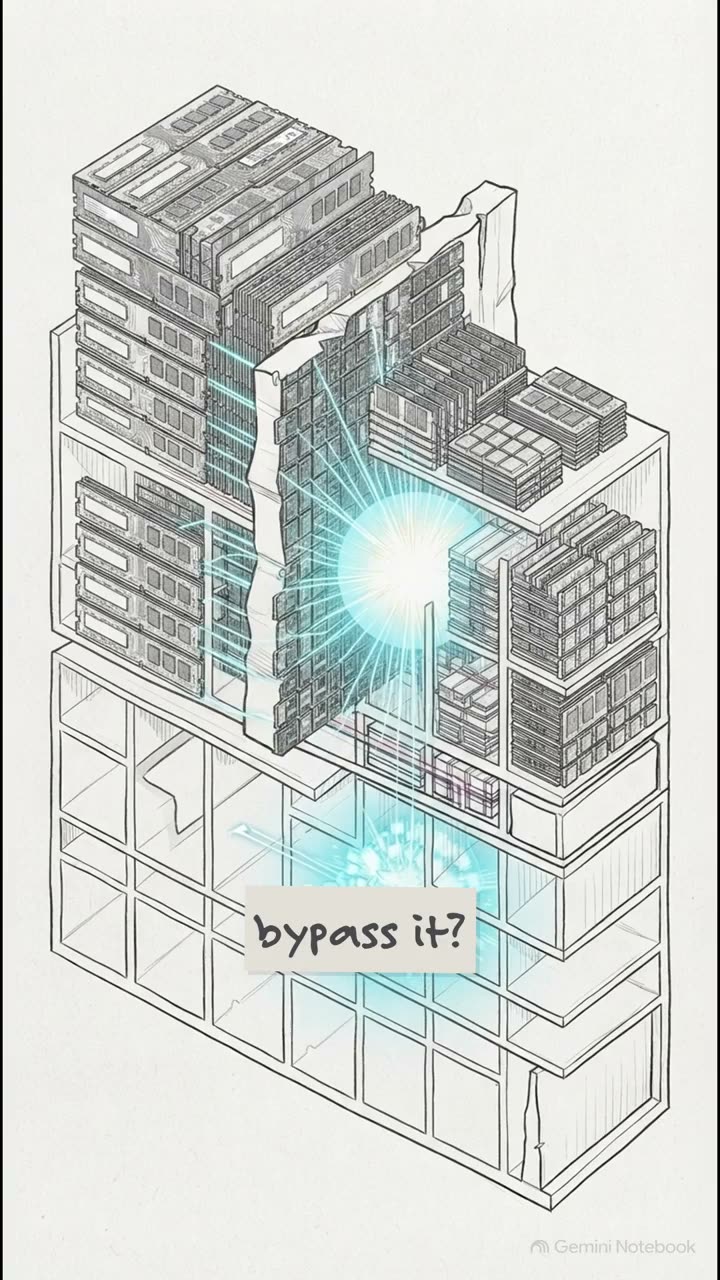
Honestly, it fundamentally changes the economics of serving large language models. Finally, section six, distillation into small models, transferring knowledge. Now, what if we want to bypass those massive parameter counts entirely at inference time?
That's where knowledge distillation comes in. KD transfers skills from an expensive, massive teacher model to a much smaller, cheaper student model. It does this surgically by using a distillation loss to minimize the differences in their softmax outputs.
By balancing these soft targets with hard ground truth labels, it essentially forces the student to mimic the soft probability distributions of the teacher's intelligence. A classic example is Distillbird, which famously retains 97% of the original model's performance while using 40% fewer parameters.
Interestingly, the authors of QLaura noted something pretty critical. Current chatbot benchmarks are just not trustworthy for accurately evaluating performance levels anymore. Instead, they found that using GPT-4 for evaluations is a cheap and reasonable alternative to human evaluation.
As we aggressively shrink these models via distillation or quantization, evaluating their true capability becomes the new bottleneck. And that's rapidly shifting the landscape toward these LLM as a judge techniques, just to keep up with the sheer pace of optimization.
Which brings us to a final provocative thought to leave you with. As 4-bit quantization, page detention, and distillation converge, will the future of local on-device inference make massive cloud clusters obsolete for the everyday technical builder?
As these scalpel-like optimizations compound, where exactly is the ceiling for local on-device intelligence? It is a fascinating space to watch. Thanks for joining this explainer and keep building.