Web Security Deep Dive
Transcript
Made automatically from the video's sound, so it may contain mistakes. Click a line to play from there.
Right, welcome to this explainer. Today we're completely ditching those basic toy-only vulnerabilities. No more hypothetical alert boxes. Instead, we're focusing strictly on real-world execution syncs, exposing the hidden flaws and dangerous escape hatches that are actually lurking right inside today's complex application frameworks.
Now, if you're already across the basics of the same origin policy, cause and content security policy from our previous discussions, you are exactly in the right place. We're about to see how the illusion of default security can be completely shattered. So here is our roadmap for today.
One, modern XSS parser contexts, two, exploiting prototype pollution, three, defeating CSRF and same-site, and four, mitigating advanced clickjacking. Let's get straight into it. Section one.
Modern XSS parser contexts and exactly when framework escapers betray you. You know how it goes. Modern frameworks, they safely bind data by default, which is brilliant. But there are always those moments when developers just need to directly manipulate the DOM.
And that is exactly when they reach for escape hatches. Things like React's dangerously set inner HTML or Angular's bypass security trust as. Whether we're talking reflected, stored or DOM-based XSS, the very moment you drop untrusted data into these subcontexts, arbitrary JavaScript execution is right back on the menu.
The same goes for allowing dynamic href assignments, SVG uploads, or using flawed markdown sanitizers. Look, we all copy-paste from Stack Overflow occasionally, but these specific hatches completely bypass your framework's built-in body armor.
The real issue is that failing to properly encode data before it hits real-world DOM syncs leads to absolutely devastating vulnerabilities. And you won't see a single traditional alert box popping up to warn you. Context matters immensely here.
Dropping data into an HTML body requires entirely different encoding than dropping it into an unquoted attribute, a JavaScript URL scheme, or a JavaScript template literal. And here's a massive pitfall.
Even inner text, which so many developers falsely assume is just bulletproof, can actually execute scripts if it's applied directly to a script tag context. You literally have to encode for the exact parser context you are in, and then often the JavaScript context as well to ensure true safety.
Moving on to section two. Exploiting prototype pollution by poisoning the global prototype chain. This flow beautifully illustrates the mechanics of a prototype pollution attack. So an attacker injects a malicious property during a recursive merge operation, or maybe via some poorly sanitized JSON input.
They'll typically use a key like proto, or they might bypass basic filters by using constructor.prototype. Now, because of how the JavaScript engine actually resolves property lookups, that malicious property isn't just added to the target object.
No, it gets added directly to the global object.prototype. Think of it like poisoning the town's water reservoir instead of just tampering with a single glass of water. Suddenly, every single object in the runtime inherits this toxic property.
And if that property hits an execution sync, a gadget, well, the attacker wins. And if you're sitting there thinking this is strictly a front-end UI problem, take a very close look at this comparison. On the client side, sure, a polluted property like a transport URL passing into a DOM gadget gives you DOM-based XSS.
But on the back end, server-side prototype pollution in Node.js environments is absolutely catastrophic. If an attacker pollutes properties that later flow into a node.js child.process.fork or an XXSync function, they instantly escalate what is effectively a quirky language feature into complete remote code execution.
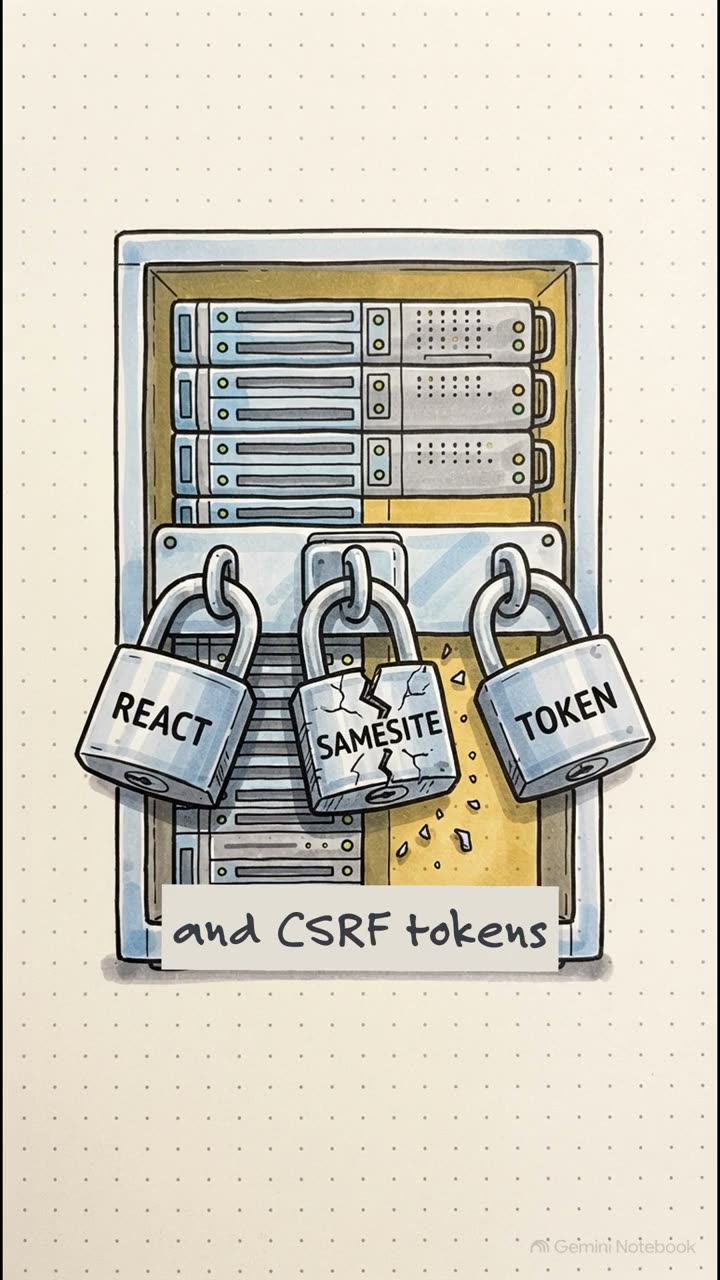
They take over your entire server, just like that. Alright, section three. Defeating CSRF and same-site, or as I like to call it, the myth of default protection.
I absolutely love highlighting this quote because it hits the nail on the head regarding the single most common way developers accidentally leave their applications wide open. So, Chromium-based browsers now default to same-site equals lax.
Sounds secure, doesn't it? But lax still allows cookies to be sent on top-level navigations if they use safe HTTP methods like get. So, if your application has a sloppy get endpoint that mutates server-side state, your same-site equals lax cookie is offering you absolutely zero protection.
But it gets worse. Beyond those top-level get mutations, attackers can easily bypass these limits using sibling subdomain attacks. You have to remember this golden rule.
On top of that, same-site does nothing, absolutely nothing, to protect against client-side CSRF. That's where malicious input forces your own same origin JavaScripts to generate and issue forge requests on behalf of the attacker.
So to actually mitigate this, you have to rely on true defense in depth. Relying solely on same site equals lax, that is low protection. For high protection, you need explicit mitigation, like the signed double submit cookie pattern, where you bind your CSRF tokens to the user's session using cryptographic HMAC signatures.
And you want to combine this by enforcing fetch metadata headers on the server side, specifically verifying the secfetch site header. Doing this establishes a highly resilient network level defense that just drops cross-site requests before they even touch your application logic.
Which naturally brings us to a rather fascinating question. If our scripts are secure and our requests are properly verified, how can the UI itself actually betray the user? What happens when the attacker doesn't forge the request, but instead tricks the user into making it themselves?
Let's look at section four, mitigating advanced clickjacking and defending the viewport. The 2010's called, and they really want their frame busters back. Legacy frame busting JavaScript just does not work anymore.
Attackers can effortlessly bypass those scripts using double framing, where accessing parent.location becomes a security violation and just silently fails. They can flush the navigation pipeline using on before onload events with no content responses.
Or honestly, they can just disable your frame busting script entirely by loading your page in an HTML5 sandbox that explicitly restricts JavaScript execution. And don't even get me started on legacy HTTP headers like XFrame Options allow from. They are completely deprecated and just ignored by modern browsers.
But attackers, they've evolved past iframes entirely anyway, using techniques like double click jacking. This completely bypasses iframe restrictions by tricking users into clicking on sensitive controls inside top-level windows.
Just imagine a user double-clicking an innocent looking button on an attacker's site. Right between that first and second click, the attacker opens your target page in a new window precisely under their cursor.
Because the target is a top-level window, traditional framing restrictions provide no defense whatsoever. And boom, that second click executes a critical action on your application. So your directive here is crystal clear.
You must cleanly mitigate frame-based threats by explicitly defining content security policy frame ancestors directives in your HTTP response headers, using either none or self. And to protect against that advanced UI redressing like double clickjacking on highly sensitive actions, you absolutely must require server-side transaction authorization.
Whatever you do, do not rely on naive frame busters. And definitely don't assume that just adding an extra client-side confirmation button is going to save you. To wrap up this explainer, I really want to challenge how you review the architecture and the dependencies you are deploying every single day.
Modern frameworks provide absolutely wonderful tools, but they do not erase the underlying chaotic mechanics of the browser. So, are you rigorously auditing your execution syncs and layering your network defenses?
Or are you simply trusting the illusion of default security? Think about it. Thanks for joining me, and until next time, keep questioning your assumptions.