
When a human lands on a website, you have fewer than 1,000 milliseconds to establish architectural credibility, convey value, and pass Core Web Vitals (Largest Contentful Paint). The hero section is the single highest-leverage surface on the web: it dictates conversion rates, SEO rankings, and user retention.
Yet in 2026, modern web development workflows for hero sections oscillate between two deeply frustrating extremes:
- The Bespoke Engineering Bog: Spending three days hand-crafting responsive media queries, fighting z-index collisions, tweaking line clamps, fixing layout shift on mobile viewports, and manually verifying WCAG AA contrast.
- The "Prompt-and-Pray" AI Trap: Asking an LLM to "generate a landing page hero for my AI startup", receiving 600 lines of unmaintainable Tailwind/CSS soup with hardcoded arbitrary hex codes, hallucinated flex containers, zero design token governance, and broken mobile viewports.
At ZumiLabs, we asked a fundamental question: What if we stop asking AI to write raw frontend code from scratch, and instead empower AI with a deterministic, token-governed compiler?
Here is the architectural breakdown of ZumiHero: why we built a zero-JS compiler, how token governance makes AI generation mathematically predictable, and how this philosophy transforms autonomous AI from a chaotic code regurgitator into a disciplined, repeatable engineering teammate.
The Core Philosophy
- Never ask AI to emit unconstrained HTML: AI excels at creative narrative, semantic structuring, and multi-perspective exploration, but struggles with sub-pixel constraints and CSS precedence.
- Data Contracts over Spaghetti Code: By constraining AI to emit strictly typed JSON schemas (governed by Zod), the output is 100% manageable, visually editable, and version-controllable.
- Deterministic Compilation: A mathematical compiler translates schema data into pure-CSS, zero-JS markup with automated WCAG AA contrast enforcement and instant multi-framework export (React, Vue, Svelte, Astro).
The Problem: Why Unconstrained AI Fails at Frontend Design
Large Language Models are probabilistic token predictors. When prompted to generate a complete visual interface, an LLM outputs CSS and HTML based on statistical patterns in its training data. This creates four fatal flaws for production web development:
| Failure Mode | What Prompted AI Emits | Production Consequence |
|---|---|---|
| Token Drift | Arbitrary hex colors (e.g. #1a202c mixed with #0f172a) |
Breaks design system consistency and re-theming |
| Contrast Regressions | Light blue badges on white backgrounds | Fails WCAG AA legal accessibility audits (< 4.5:1) |
| Runtime Bloat | Bulky JS libraries (Swiper.js, Framer Motion) for simple carousels | Degrades LCP, blocks the main thread, inflates bundles |
| Zero Editability | Monolithic 700-line JSX files | Content authors cannot tweak copy without touching raw code |
To solve this, we inverted the relationship: The AI generates the intent (the Schema); our Compiler generates the implementation (the Code).
Strict HeroConfiguration Schema
Validated via Zod schema bounds with cross-field consistency guarantees.
Mathematical Execution & Automated Auditing
clamp() scaling from 320px mobile to 4K
:checked radio inputs
Direct Canvas Manipulation
Right-click inspector jumps, zero-lag inline text editing, and 5-step guided wizard.
Zero-JS Framework Exporters
React/Next.js, Vue 3, Svelte 5, Astro, and pure HTML/CSS bundles with File System Access.
1. The Schema Contract: Turning Design into Data
At the core of ZumiHero is a strict, versioned data contract (HeroConfiguration). Every hero component in ZumiHero is represented as a pure JSON data structure without a single line of raw CSS or HTML:
// Example: A complete hero represented as a strict schema contract
{
  "version": "4.3.0",
  "title": "Autonomous AI Coding Swarms",
  "composition": {
    "family": "split-media",
    "mediaSide": "right",
    "density": "comfortable",
    "containerWidth": "1280px",
    "minHeight": "620px"
  },
  "content": {
    "badge": "🤖 AGY 2.0 Engine Live",
    "title": "The AI pair programmer that executes in your local terminal",
    "subtitle": "Orchestrate autonomous agent swarms to resolve lint errors and write unit test suites.",
    "primaryCta": { "label": "Install CLI via npm", "href": "https://zumilabs.com/cli", "emphasis": "primary" },
    "proof": { "kind": "rating", "score": 4.95, "label": "from 3,200+ platform engineers" }
  },
  "environment": {
    "kind": "gradient",
    "angle": 135,
    "stops": "custom",
    "customStops": [
      { "color": "#0ea5e9", "position": 0 },
      { "color": "#8b5cf6", "position": 50 },
      { "color": "#ec4899", "position": 100 }
    ]
  },
  "media": { "kind": "browser-frame", "asset": "product-wide" }
}
Because the schema is validated with Zod, an AI agent cannot hallucinate invalid properties. If an agent tries to specify an invalid offset or an unmapped color token, the validator rejects it before it ever touches the browser.
2. Zero-JS by Default: Pure-CSS State Machines
Every kilobyte of JavaScript executed before the first paint delays Largest Contentful Paint (LCP). For a hero section, JavaScript is almost entirely unnecessary.
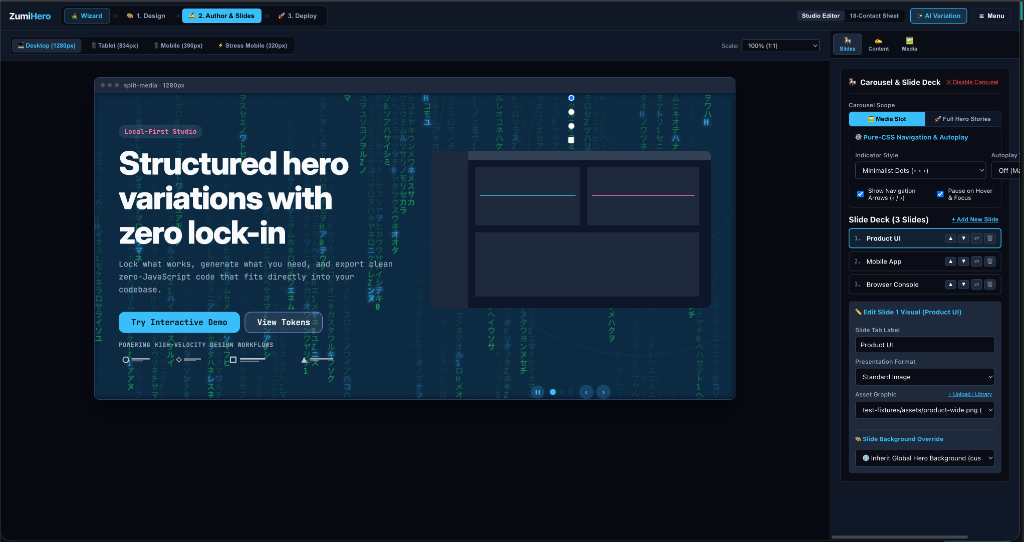
ZumiHero introduces pure-CSS state machines for rich interactivity:
- Pure-CSS Multi-Slide Story Decks: Interactive carousels, tabs, and slide sequences operate entirely via hidden HTML radio buttons (
input[type="radio"]) and CSS sibling selectors (:checked ~ .zh-slide). There is zero JavaScript required for slide switching, pause-on-hover, or autoplay animations. - Fluid Responsive Typography: Fluid type scales use mathematical
clamp()functions that seamlessly scale headlines from 320px mobile screens to 4K ultrawide displays without layout recalculations or JavaScript resize listeners. - Hardware-Accelerated Atmosphere: Background drift animations, pulsing radial gradients, and geometric grid overlays execute entirely on the GPU via CSS transforms and opacity transitions.
"Eliminating runtime JavaScript from the critical rendering path ensures deterministic 100/100 Google Lighthouse scores and zero hydration delays."
3. Mathematical Accessibility & Automatic Contrast Solving
Most AI-generated websites fail basic accessibility standards because models pick colors that look visually striking in isolation but violate contrast requirements against background scrims.
ZumiHero builds accessibility directly into the compilation pipeline:
- Automated Relative Luminance Calculation: When an author or AI selects a background color or video backdrop, the compiler calculates the exact luminance of the canvas:
L = 0.2126 * R_sRGB + 0.7152 * G_sRGB + 0.0722 * B_sRGB - Automated Scrim Solving: If a video or photo background lacks sufficient contrast for text readability, the compiler automatically solves the required overlay opacity (e.g.
overlayOpacity: 0.42) to guarantee a WCAG AA contrast ratio of at least 4.5:1 for body text and 3.0:1 for large headings. - Focus Ring & Badge Inversion: Focus rings, badge borders, and secondary buttons are automatically calculated against surface colors, preventing invisible focus states during keyboard navigation.
4. Direct Canvas Manipulation: Bridging Visual & Structural Editing
One of the biggest frustrations with AI web generation is the lack of direct visual control once code is created. In traditional AI tools, tweaking a headline requires asking the AI again and hoping it doesn't break the layout.
ZumiHero solves this with bidirectional direct manipulation:
- Right-Click Contextual Navigation: Right-clicking any element on the live preview canvas (a headline, a video frame, an SLA metric, or a background gradient) immediately jumps the inspector to the exact property panel responsible for that element.
- Inline Real-Time Canvas Editing: Double-clicking text directly inside the canvas allows authors to type live edits with zero character lag, synchronizing the underlying schema state instantaneously without re-rendering the iframe sandbox.
- Progressive 3-Stage Workflow:
- Stage 1 (Design): Visual blueprints, token governance, atmosphere & micro-typography.
- Stage 2 (Author): Multi-slide narrative decks, real-time copy mutations, CTA hierarchies, and proof metrics.
- Stage 3 (Deploy): Multi-framework compilation (React, Vue, Svelte, Astro, HTML/CSS), File System Access (FSA) directory writing, and standalone self-contained ZIP bundles.
5. How Autonomous AI Uses ZumiHero (The `zumihero-builder` Skill)
The true power of this architecture is how it empowers autonomous AI agents. Rather than asking an AI agent to "write frontend code", we equip the agent with the zumihero-builder skill and the deterministic compiler.
When given a high-level user request (e.g. "Design a high-converting hero for a clinical genomics platform in dark emerald with 4 key metrics"), the AI agent executes a structured workflow:
Agent analyzes domain archetype, conversion objectives, and target brand typography.
Agent synthesizes a valid HeroConfiguration JSON schema matching strict Zod bounds.
Schema is validated with Vitest unit tests and Playwright headless browser rendering.
Mathematical APCA/WCAG AA solver validates text readability and auto-adjusts scrim opacity.
Compiler emits clean, manageable React, Vue, Svelte, and Astro components ready for production.
Because the agent operates on the schema rather than raw CSS, the resulting hero is guaranteed to be responsive, accessible, token-governed, and easily editable by human designers in the visual Studio.
Conclusion: Repeatable Systems over Unconstrained Prompts
AI will continue to transform software engineering, but raw prompt generation is a dead end for production design systems. True productivity comes from giving AI high-leverage, deterministic tools: strict schemas, mathematical compilers, and token governance.
With ZumiHero, we have created an engine where designers, content authors, and autonomous AI agents can collaborate on the same canvas — producing production-grade, zero-JS web flagships that look exceptional, load in milliseconds, and stand the test of time.
Design, Generate, and Export Production Heroes in Seconds
Explore all 21 pre-built industry presets, test pure-CSS carousels, configure multi-stop atmosphere gradients, and export zero-JS components directly to React, Vue, Svelte, and Astro.
🚀 Launch ZumiHero Studio